



The Economic Community of West African States (ECOWAS) has hit the panic button. In an unprecedented move, the regional bloc has declared a State of Emergency across West Africa following a fresh wave of coups and attempted military takeovers.
But as ECOWAS scrambles to deploy standby forces and issue sanctions, one leader is offering a different—and perhaps uncomfortable—solution. Ghana’s President, John Dramani Mahama, has “fired back” with a lecture that hits at the root cause of the instability: the failure of democratic leadership itself.
Here is a breakdown of the “Red Alert” situation and Mahama’s bold message to his peers.
1. Why ECOWAS Declared a State of Emergency
The trigger for this emergency declaration was a series of rapid-fire political crises in December 2025.
- The Benin Coup Attempt: Just days ago, security forces in Benin foiled an attempted coup, prompting ECOWAS to deploy its standby force immediately.
- Guinea-Bissau Instability: This follows a successful military takeover in Guinea-Bissau in November.
- The “High Risk” Rating: ECOWAS Commission President Omar Touray announced that the region now faces an “average high-risk rating,” citing terrorism, banditry, and the erosion of electoral inclusivity.
The bloc is panicked. The fear is that the “coup contagion” is spreading faster than democracy can contain it. Their proposed solutions? Sanctions, asset freezes, travel bans, and military intervention.
2. Mahama’s “Lecture”: It’s Not Just About the Military
While ECOWAS focuses on the symptoms (the soldiers), President Mahama is focused on the disease (bad governance).
In his address, Mahama warned that Ghana—often seen as a beacon of stability—is “not immune to coups”. He argued that the military doesn’t just wake up and decide to take over; they step in when the people lose trust in their elected leaders.
Mahama’s 3-Point Diagnosis:
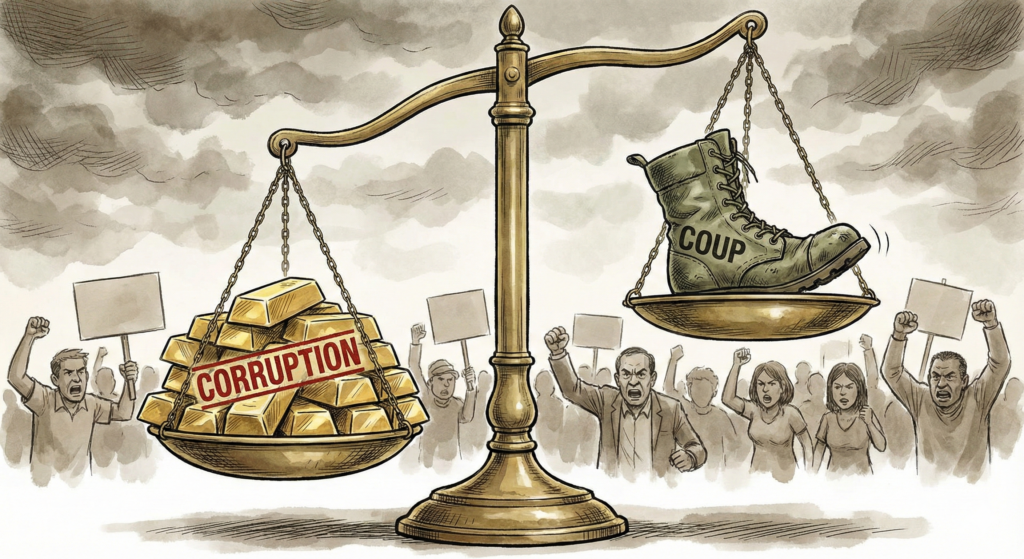
- Lack of Accountability: Politicians looting the state and protecting each other.
- Abuse of Public Trust: Leaders using their office for personal gain rather than public service.
- Corruption: The cancer that eats away at the legitimacy of democracy.
“If ECOWAS should declare a state of emergency at all… they should declare it against looting, corruption, and lack of accountability.”
3. The Applause for the Military
A chilling anecdote from the video highlights the depth of the problem. Mahama noted that during his recent inauguration, the loudest applause from the crowd was not for the visiting presidents or politicians—it was for the military leaders.
This signals a dangerous shift: the citizens of West Africa are beginning to see soldiers as “saviors” and politicians as the problem. If ECOWAS only fights the soldiers without fixing the politics, they are fighting a losing battle.
4. What Happens Next? The ECOWAS Playbook
Despite Mahama’s advice, ECOWAS is likely to proceed with its traditional playbook:
- Diplomatic Isolation: Freezing out coup leaders from the international community.
- Economic Sanctions: Closing borders and stopping trade (a measure that often hurts ordinary citizens more than the junta).
- Military Intervention: The “last resort” option, similar to the intervention in The Gambia in 2017.
However, the video analysis argues that these measures are superficial. As long as insecurity rages in places like Nigeria—where kidnapping and banditry are daily realities—ECOWAS’s focus on “regime protection” rather than “citizen protection” will appear misplaced.
A Wake-Up Call
The declaration of a State of Emergency is a sign that West Africa is at a tipping point. President Mahama’s message is a crucial wake-up call: You cannot force democracy on a people who feel betrayed by it.
Unless ECOWAS leaders start policing themselves as aggressively as they police military juntas, the “Red Alert” may become the permanent status of the region.
Do you agree with President Mahama? Is bad governance the real cause of coups? Share your thoughts below.
Watch the full breakdown here:





Leave a comment