



Albert Einstein spent the latter half of his life trying to prove that quantum mechanics was “spooky” and incomplete. He could not accept that the universe would allow for action at a distance—the idea that something happening in one part of the galaxy could instantly affect something else millions of miles away.
However, as revealed in the deep dive by Veritasium, history has shown that Einstein’s “nightmare” was actually a reality. Through the work of John Bell and subsequent experimentalists, we now know that our universe is fundamentally non-local. But what does that actually mean for the laws of physics?
1. The EPR Paradox: The Search for “Hidden Variables”
In 1935, Einstein, Podolsky, and Rosen (EPR) argued that if quantum mechanics were correct, it would violate the principle of locality. They proposed that entangled particles must carry “hidden variables”—pre-set instructions—that tell them how to behave before they are even measured.
Think of it like two envelopes: one contains a “plus” and one a “minus.” When you open one, you instantly know what’s in the other, but nothing actually “traveled” between them. This local explanation felt much more sensible than the “spooky” quantum alternative.
2. John Bell’s Mathematical Breakthrough
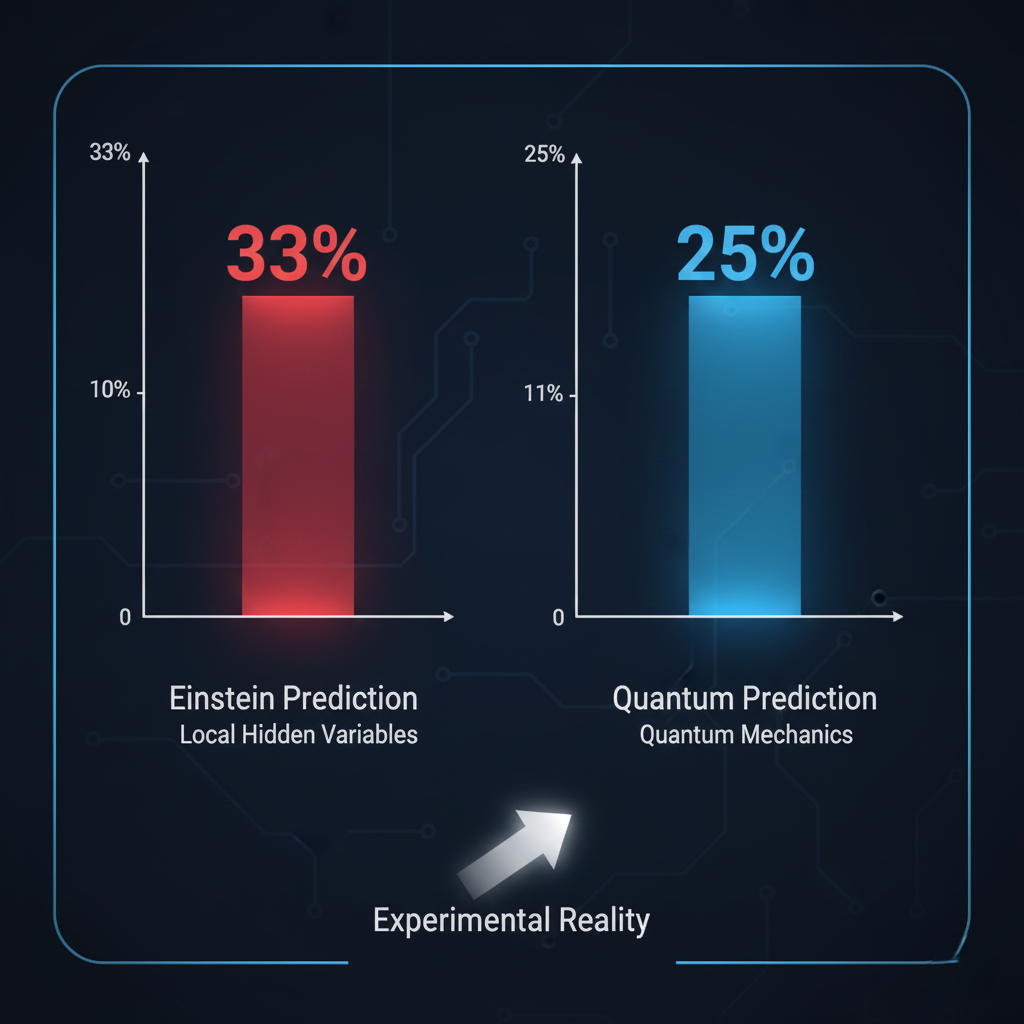
For decades, the Einstein-Bohr debate was considered “armchair philosophy” because both sides predicted the same results for simple experiments. That changed in 1964 when John Bell realized that by rotating the measurement devices, the two theories would produce different statistical outcomes.
- The Hidden Variable Limit: Bell calculated that if Einstein were right, the particles would disagree at least 33% of the time.
- The Quantum Reality: Quantum mechanics predicted they would only disagree 25% of the time.
When the experiment was finally run in a lab, the result was exactly 25%. Quantum mechanics was right; local hidden variables were impossible.
3. Why This Doesn’t Break the Speed of Light
If things are happening “instantly,” why can’t we send messages faster than light?
- The Randomness Factor: When you measure an entangled particle, the result is completely random (plus or minus). You cannot “choose” the result.
- The Correlation: Your friend’s result will be perfectly correlated with yours, but because both results are random, no information can be encoded or transmitted.
Relativity’s “Universal Speed Limit” for information remains intact, but the underlying fabric of reality is much more interconnected than Einstein ever imagined.
4. Is the “Many Worlds” Theory the Solution?
Some physicists argue that we can avoid this non-local “spookiness” by adopting the Many Worlds Interpretation.
- No Collapse: In this view, there is no “collapse” of the wave function. Instead, the universe splits, and both outcomes happen in parallel branches.
- Locality Recovered? Because all versions of the measurement occur, the particles don’t need to “communicate” to decide a state, potentially preserving Einstein’s dream of a local description of reality.

Conclusion: Beyond “Shut Up and Calculate”
Bell’s Theorem took a philosophical debate and turned it into hard science. It proved that Einstein was right to be concerned about locality, even if he was wrong about how the universe worked. Today, entanglement is the foundation of quantum computing and secure communication—proof that the “spooky” parts of physics are its most powerful.
Watch the full documentary on Bell’s Theorem here: There Is Something Faster Than Light | Veritasium

















Leave a comment